RotorcraftMixing
This page describe how to compute "mixing" for an arbitrary multirotors configuration.

Introduction
"Mixing" consist in converting rotational accelerations commands computed by the autopilot into throttle commands for each of the motor controllers.
Let us consider a vehicle comprising a set of identical fixed pitch rotors Failed to parse (MathML with SVG or PNG fallback (recommended for modern browsers and accessibility tools): Invalid response ("Math extension cannot connect to Restbase.") from server "https://wikimedia.org/api/rest_v1/":): {\displaystyle R_i, i \in[1:N]} located at coordinates and spinning in the same plane in the direction Failed to parse (MathML with SVG or PNG fallback (recommended for modern browsers and accessibility tools): Invalid response ("Math extension cannot connect to Restbase.") from server "https://wikimedia.org/api/rest_v1/":): {\displaystyle D_i, i\in[1:N], D_i\in[-1;1]} at a rotational speed Failed to parse (MathML with SVG or PNG fallback (recommended for modern browsers and accessibility tools): Invalid response ("Math extension cannot connect to Restbase.") from server "https://wikimedia.org/api/rest_v1/":): {\displaystyle \omega_i, i\in[1:N]} .

![{\displaystyle (X_{i},Y_{i},0),i\in [1:N]}](https://wikimedia.org/api/rest_v1/media/math/render/svg/1a45f0e29a626151876388cad6f2b0fe1a17c48d)
Assuming a quasi hovering regime, the force produced by each rotor can be considered normal to the rotor plane and proportional to the square of its rotational speed. Expressed in body frame ( front, right, down ), this leads to Failed to parse (MathML with SVG or PNG fallback (recommended for modern browsers and accessibility tools): Invalid response ("Math extension cannot connect to Restbase.") from server "https://wikimedia.org/api/rest_v1/":): {\displaystyle \overrightarrow{F}_{i}^{B} = \begin{pmatrix}0\\0\\-C_t \omega_i^2\end{pmatrix} }
Under the same assumption, the torque produced by each rotor can also be assumed to be in the same direction and proportional to the square of the rotational speed.
The torque produced by each rotor around the CG, expressed in body frame can then be writen
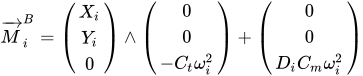
Failed to parse (MathML with SVG or PNG fallback (recommended for modern browsers and accessibility tools): Invalid response ("Math extension cannot connect to Restbase.") from server "https://wikimedia.org/api/rest_v1/":): {\displaystyle \overrightarrow{M}_{i}^{B} = C_t \omega_i^2 \begin{pmatrix}-Y_i \\X_i \\D_i \frac{C_m}{C_t}\end{pmatrix} }
Where is a "thrust" coefficient and is a "torque" coefficient. It has been measured experimentally that Failed to parse (MathML with SVG or PNG fallback (recommended for modern browsers and accessibility tools): Invalid response ("Math extension cannot connect to Restbase.") from server "https://wikimedia.org/api/rest_v1/":): {\displaystyle \frac{Ct}{Cm} \approx 10} on a mikrokopter.


As a first approximation we can consider that the rotational speed of the propeller is proportional to the square root of the applied command Failed to parse (MathML with SVG or PNG fallback (recommended for modern browsers and accessibility tools): Invalid response ("Math extension cannot connect to Restbase.") from server "https://wikimedia.org/api/rest_v1/":): {\displaystyle u_i}
Failed to parse (MathML with SVG or PNG fallback (recommended for modern browsers and accessibility tools): Invalid response ("Math extension cannot connect to Restbase.") from server "https://wikimedia.org/api/rest_v1/":): {\displaystyle \omega_i^2 = K u_i }
This allows us to express the torque produced by the set of rotors as
Failed to parse (MathML with SVG or PNG fallback (recommended for modern browsers and accessibility tools): Invalid response ("Math extension cannot connect to Restbase.") from server "https://wikimedia.org/api/rest_v1/":): {\displaystyle \overrightarrow{M}^{B} = \sum_{i=1}^{N} \overrightarrow{M}_{i}^{B} = K C_t \begin{pmatrix} -\sum_{i=1}^{N} Y_i u_i\\ \sum_{i=1}^{N} X_i u_i\\ \frac{C_m}{C_t} \sum_{i=1}^{N} D_i u_i \end{pmatrix} }
which can be rewriten as a matrix vector product
Failed to parse (MathML with SVG or PNG fallback (recommended for modern browsers and accessibility tools): Invalid response ("Math extension cannot connect to Restbase.") from server "https://wikimedia.org/api/rest_v1/":): {\displaystyle \overrightarrow{M}^{B} = K C_t \begin{pmatrix} -Y_1&-Y_2&\ldots&-Y_n\\ X_1& X_2&\ldots& X_n\\ \frac{C_m}{Ct}D_1&\frac{C_m}{Ct}D_2&\ldots&\frac{C_m}{Ct}D_n \end{pmatrix} \begin{pmatrix} u_1\\ u_2\\ \vdots\\ u_n \end{pmatrix} }

is a matrix describing the geometric positions of our rotors and Failed to parse (MathML with SVG or PNG fallback (recommended for modern browsers and accessibility tools): Invalid response ("Math extension cannot connect to Restbase.") from server "https://wikimedia.org/api/rest_v1/":): {\displaystyle U} is the vector of throttle commands for our set of motor controllers.


In order to express the command applied to each power train as a function of the momentum we want to apply to our vehicle, we need to find , a matrix such as


If Failed to parse (MathML with SVG or PNG fallback (recommended for modern browsers and accessibility tools): Invalid response ("Math extension cannot connect to Restbase.") from server "https://wikimedia.org/api/rest_v1/":): {\displaystyle A} has rank 3, we know that such a matrix exists (yeah, we can't do 2 rotors or have all rotors aligned), and in this case, we have the relationship

We know that one solution of this equation is the Moore-Penrose pseudoinverse of . Furthermore, this solution is the one leading to the power train command vector having the smallest euclidian norm, which is interesting as it optimizes the repartion of our control effort across our power trains.
Example
Let's consider the following H hexarotors configuration.


The first two lines of the matrix represent the coordinates of each rotor in the plane, and the third line the direction in which they spin. Note that in this example the X axis is vertical, and the Y coordinates are in the top row of .

Failed to parse (MathML with SVG or PNG fallback (recommended for modern browsers and accessibility tools): Invalid response ("Math extension cannot connect to Restbase.") from server "https://wikimedia.org/api/rest_v1/":): {\displaystyle B = \begin{pmatrix} -0.24 & -0.71 & -1.47 \\ 0.241 & -0.71 & 1.47 \\ -0.93 & 0. & 2.44 \\ 0.93 & 0. & -2.44 \\ -0.69 & 0.71 & -1.09 \\ 0.69 & 0.71 & 1.09 \end{pmatrix} }
Normalizing columns of yelds
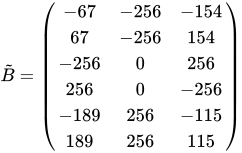
which in turns yelds the following supervision section
   <section name="SUPERVISION" prefix="SUPERVISION_">
    <define name="MIN_MOTOR" value="3"/>
    <define name="MAX_MOTOR" value="200"/>
    <define name="TRIM_A" value="0"/>
    <define name="TRIM_E" value="0"/>
    <define name="TRIM_R" value="0"/>
    <define name="NB_MOTOR" value="6"/>
    <define name="SCALE" value="256"/>
    <define name="ROLL_COEF"   value="{ -67,    67, -256,  256, -189,  189}"/>
    <define name="PITCH_COEF"  value="{ -256, -256,    0,    0,  256,  256}"/>
    <define name="YAW_COEF"    value="{ -154,  154,  256, -256, -115,  115}"/>
    <define name="THRUST_COEF" value="{  256,  256,  256,  256,  256,  256}"/>
  </section>
The above computation can be performed using the following simple octave script (sudo apt-get install octave3.2)
octave
copy the flowing commands in the terminal: (ncol is the number of col from matrix B. in this example = 3 )
exit
A = [
   -0.17  0.17   -0.25  0.25   -0.33   0.33
  -0.35   -0.35   0.     0.     0.35    0.35
  -0.1     0.1    0.1   -0.1   -0.1     0.1
];

B = pinv(A)

m = max(abs(B))

[nrow,ncol] = size(B)

for i=1:ncol
   Btilde(:,i) = B(:,i)/m(i);
end

Btilde =  round(256*Btilde)